Power Systems Control
Centralized Power Monitoring and Control for Remote Infrastructure
Maintaining reliable power across distributed infrastructure requires visibility into the systems that support each site. Asentria provides centralized monitoring and control capabilities that help organizations manage power systems more effectively.
Power Failure Isn’t a Threat with SiteBoss
Power outages can bring communications, utilities, and critical infrastructure to a standstill, but only if you’re relying on disconnected, reactive power systems. In this video, learn how the SiteBoss® Site Controller delivers automated power control for remote sites, keeping networks online during outages.
Maintain Stability Across Distributed Power Systems
Power environments at remote sites often include multiple systems working together to support operations. Asentria enables operators to monitor power conditions, identify potential issues early, and maintain operational stability across distributed locations.
With centralized insight into power systems, organizations can improve uptime, reduce operational risk, and ensure consistent performance across their network.
Industries that rely on Power Systems Control
Telecommunications
Managing towers, base stations and cabinets worldwide.
Power Utilities
Automating substations and distributed grids.
Microgrids
Managing localized energy generation and storage.
Datacenters
Supervising edge and distributed IT facilities.
Public Safety
Ensuring reliability for radio and emergency systems.
See more Industries
OUR EXPERTISE COMES FROM REAL LIFE EXPERIENCES
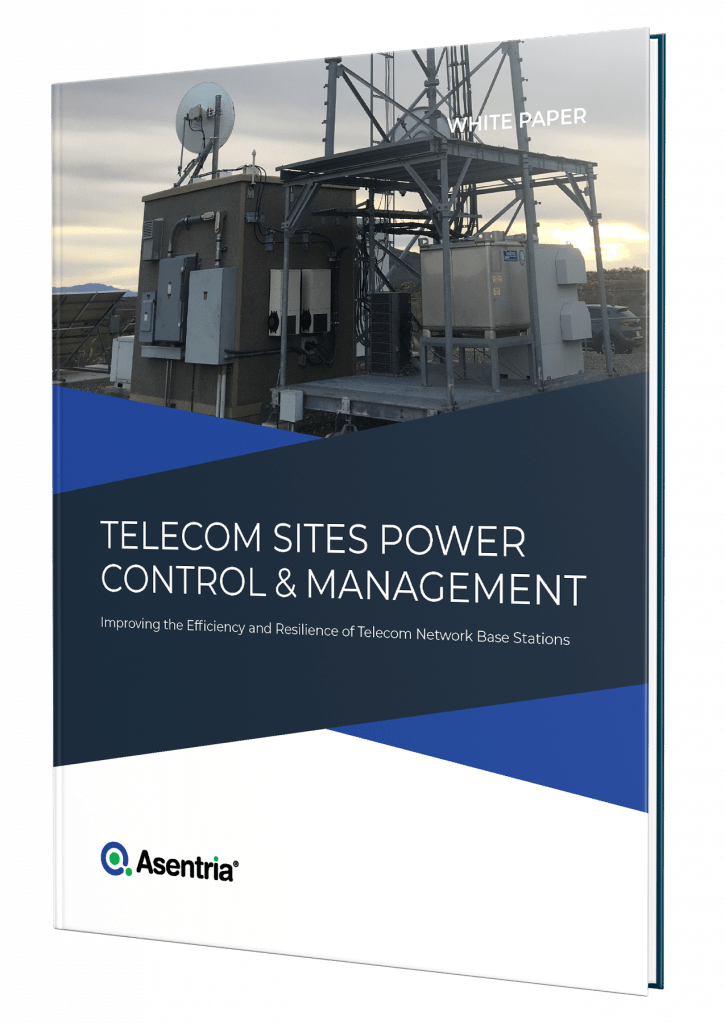
EXPLORE more: Telecom Sites Power Control & Management
Power issues are the most fundamental item that network operators need to monitor and manage at remote sites. The ability to remotely monitor and reboot equipment contributes to both network resilience and network efficiency. Effective monitoring of various power-related sub-systems (AC meters, generators, DC rectifiers, batteries, fuel cells, solar arrays, or other newer hybrid power systems) can give a complete picture of power-related issues at a site. This allows for better troubleshooting and reduced downtime of the network due to power-related faults. Automation, like an immediate reboot of malfunctioning DC or AC powered equipment at a remote site, reduces network downtime and also saves a costly truck roll.
This white paper report provides details of the leading cause of telecom power outages, and the benefits of more advanced cell site automation applications involving power management.
main topics
- The leading cause of telecom site power outages in different geographic regions of the world.
- Methods to reduce the impact on a telecom network caused by power outages.
- Reducing costs of operating a communication network with automation.
- Dispatching service personnel less often, and with valuable data regarding what problems they may encounter once they reach the site.
MORE case studies
Implementing Power Visibility for Off-Grid Solar Hybrid Sites using the SiteBoss Site Controller
Summary: Mountaintops and other higher altitude locations are excellent places to locate telecom sites due to the vast distances that can be covered from a single point. At the same time, mountaintops are difficult-to-reach sites locations that can make monitoring and service visits highly expensive, time-consuming, and even impossible during certain times of the year. Often AC grid power at these sites is impractical and some other power source needs to be provisioned. Asentria began working with a North American mobile network operator to address issues for remote sites that had no grid power available.
This technical case study goes into technical details of how this solution was implemented for this customer and what technical features of the SiteBoss were used in order to achieve the project objectives.
Case Study Introduction
Public safety networks have somewhat different needs than other networks. Especially in a large region with high temperatures like in the Middle East, network resiliency is a paramount concern. One of the main concerns with country-wide deployment is the fact that some sites can be located in extremely remote and distant locations that can be accessed only with great difficulty. The risk is that in the case of a power loss, it may take some time for a field service team to reach the site which means that implementation of backup power sources is of utmost importance.
Customer challenge
Initially, the client had some minor operational issues with their network and reached out to Asentria for assistance for a quick fix. But as soon as the client realized Asentria’s true potential and capabilities, they decided to expand the project and started asking the team to integrate more of Asentria’s technology devices into their equipment.
Later on, as the client was moving further with their plans of integrating sites in a country-wide deployment, they realized that Asentria offered solutions to problems they didn’t think had a reasonable solution. Some of those sites were in extremely remote and distant locations which meant that in the event of a power loss, the affected site would have to operate on backup power sources as long as possible until a fix could be implemented. A primary concern was then to find new ways to extend the diesel fuel levels at the remote sites.
Project Objectives
- Extend diesel fuel levels at sites
- Improve backup power sources
- Lower operating expenses
Solution
The Asentria engineering team worked with the client to integrate generators and as the client’s operator began to better understand the capabilities of the SiteBoss, a new Telecom Site Automation program was outlined and deployed. The SiteBoss was interfaced to the HVAC system, the generator, and the rectifier. When the site was running on the generator, the site operated similarly to when it was on grid power, with all equipment in operation.
However, when the site was running on batteries, the HVAC system would not operate. In order to fix this other issue, an automation was created so that the SiteBoss would watch the site temperature and battery discharge levels from the DC rectifier. This meant that the site would operate on batteries as long as the state of charge of the batteries was high enough and the temperature was low enough. Otherwise, the generator would run until batteries hit a high state of charge and the site was sufficiently cool. This cycling enabled diesel fuel levels at a remote site to be considerably extended.
Additionally, the SiteBoss control system could intelligently decide when to use the economizer to bring in cooler outside air. At the same time, the remote access helped operations managers and technicians more easily manage their HVAC systems.
Customer benefits
- Extend site life in cases of primary power loss.
- Secure remote access to on-site equipment interfaces
- Remote control and alarming
- External environmental sensors supplied by Asentria
- Adjunct engineering from Asentria, integrated solution
Summary
This is a Case Study Summary. A companion Technical Case Study provides substantial technical details as to specifically how the project was accomplished. You can download load the PDF for that study here:

Introduction
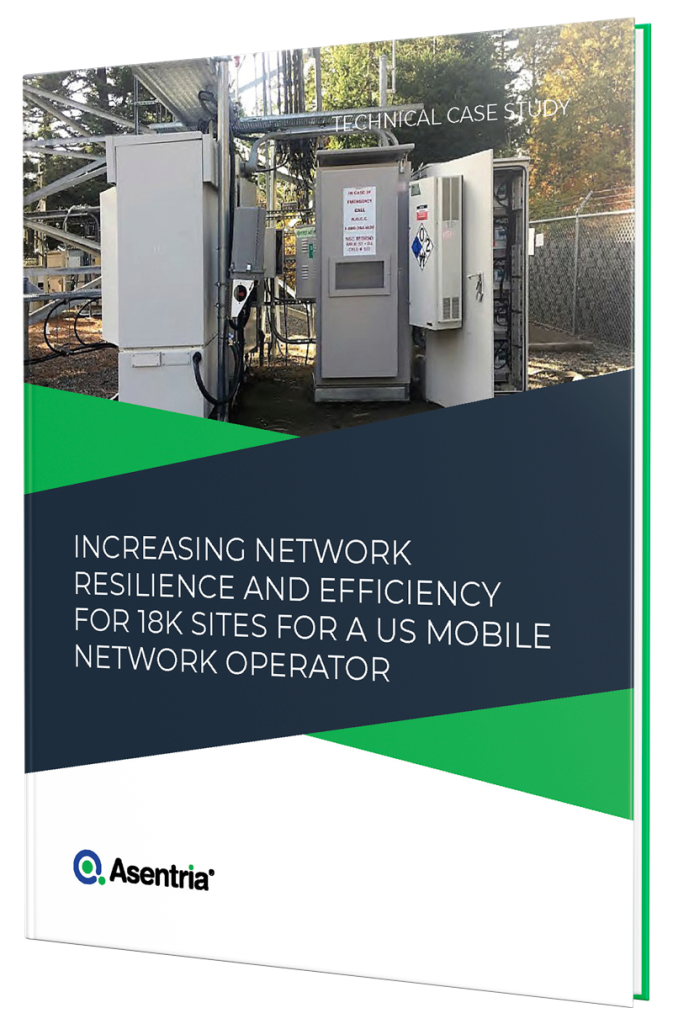
The customer is a North American mobile network operator with remote cabinet sites implemented nationwide. Their plan was to build a very large network, deploying Asentria’s devices as the network itself was deployed. It was a cabinet solution, so Asentria’s products were designed to be integrated into cabinets in an integration facility before being sent to individual locations for deployment. The client’s main interest was in Asentria’s ability to do DC reboot and provide cellular wireless out-of-band coverage.
Customer at a Glance
- Industry: Telecom – Mobile Network Operator
- Location: USA
- Network size: 40,000 sites
Project at a Glance
- No of sites: 18,000 at peak
- Project duration (# of days): 4 years
- Installed products: SiteBoss S571
- Included services: Software Integration and Hardware Development
- Main Benefit: Remote and out-of-band access to cabinet locations via wireless modems. DC reboot ability. If backhaul is lost, out-of-band connectivity allows for an ability to troubleshoot and reboot.
Download our free case study that provides substantial technical details as to specifically how the project was accomplished:
Executive Summary
Recent weather-related disasters have illustrated both the public’s reliance on cell phones for communicating in emergency situations, as well as the effect of widespread power outages on the cellular network itself. Cellular phones are no longer considered an additional method of communication for many people, instead they are their only means of communicating. The cellular network can be considered an important part of the public safety infrastructure.
This case study describes what occurred to the cellular network in the northeastern United States during recent hurricanes, and the subsequent steps taken by one wireless network operator to improve the management of the backup generators and related systems on their network.
Want to Learn More?
Download our full Product Guide or contact our team.
KNOWLEDGE hub
High-value assets, network diagrams, deployment guides, and troubleshooting playbooks ready to download for free.