

Why Copper Prices Are Now a Network Reliability Risk
Copper wire has powered telecom and utility networks for more than a century. It still runs through poles, manholes, cabinets, and shelters across the United States. But as copper prices reach historic highs, that legacy infrastructure is becoming a growing operational risk.
Rising copper prices have increased theft and vandalism across communication networks, power systems, and public infrastructure. When copper is cut or removed, the impact extends far beyond material loss. Power continuity is disrupted, network access is compromised, and critical services such as emergency communications can be affected.
For operators managing remote telecom and utility sites, copper theft is no longer just a security concern. It is a reliability challenge that directly impacts uptime, recovery time, and operational cost.
In these scenarios, resilience depends on more than physical assets. It requires accurate visibility into site conditions, the ability to operate locally when connectivity is lost, and reliable operational data once systems reconnect.
Copper Theft at Scale Is No Longer Isolated
Recent reporting highlights how widespread and damaging copper theft has become. In the United States alone, thousands of destructive attacks on communication networks are reported each year, affecting millions of customers. Major metropolitan areas, rural corridors, and critical infrastructure zones are all impacted.
For telecom operators, copper theft often causes cascading failures:
- Loss of commercial power feeding remote sites
- Generator runtime without proper monitoring or optimization
- Loss of visibility when backhaul connectivity is interrupted
- Emergency dispatches under unsafe conditions
- Prolonged outages and slow service restoration
Even as operators accelerate fiber deployment, large portions of copper infrastructure remain active. Until every legacy connection is retired, these assets remain exposed and operationally critical.
When Copper Is Cut, Power Becomes the Priority
Copper theft frequently results in sudden power loss at remote sites. When commercial power fails, backup generators and batteries become the final line of defense for maintaining network availability.
Traditional generator monitoring systems typically report basic states such as on, off, or fault. They do not provide coordinated site awareness or autonomous control when connectivity to centralized systems is unavailable.
During large-scale incidents, that limitation becomes a critical risk. Sites must continue operating safely and efficiently even when network backhaul is lost.
Intelligent Local Control with SiteBoss® Site Controller
The SiteBoss® Site Controller is designed to address these challenges by providing autonomous, site-level power control and monitoring.
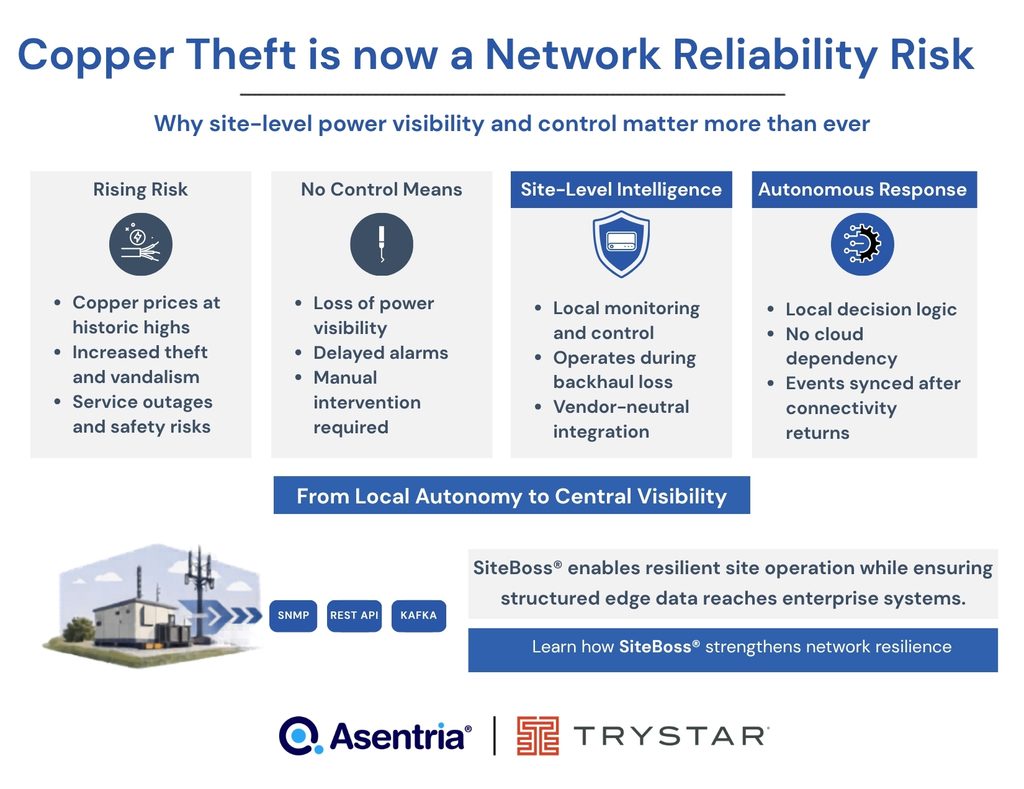
SiteBoss® collects real-time data from generators, batteries, rectifiers, and environmental sensors. More importantly, it can act locally using on-device Lua scripting when connectivity to the Network Operations Center is unavailable.
This local logic allows sites to respond immediately to changing conditions without waiting for remote commands.
Examples of autonomous behavior include:
- Detecting low battery voltage and initiating generator start sequences
- Monitoring generator runtime and temperature to prevent overheating or inefficient operation
- Identifying unexpected fuel drops while voltage remains stable and logging potential theft or leak events
- Adjusting HVAC behavior to reduce load during extended outages
All actions are logged locally and synchronized with central systems once connectivity is restored. No operational data is lost during outages.
Coordinated Power and Environmental Awareness
SiteBoss® does not treat generators as isolated assets. It integrates power systems with the full site environment to support coordinated decision-making.
Supported interfaces include:
- SNMP and Modbus RTU/TCP for generators, rectifiers, and inverters
- Dry contacts and analog inputs for fuel, battery health, temperature, and humidity
- Relay outputs for generator control, alarms, and environmental systems
- REST API and Kafka for structured edge data export
This vendor-neutral approach allows operators to apply consistent control and monitoring logic across mixed and legacy environments without replacing existing infrastructure.
Field Impact During Large-Scale Outages
In regions affected by storms, wildfires, or coordinated theft activity, SiteBoss® enables each site to operate independently while maintaining fleet-level visibility.
When grid power is lost due to copper theft or infrastructure damage:
- Sites execute local power management logic automatically
- Generators operate based on defined thresholds and runtime policies
- Non-critical loads can be reduced to preserve available energy
- Events are recorded locally and synchronized to the NOC once communication is restored
This approach reduces emergency dispatches, shortens recovery time, and provides clear post-event insight into site behavior.
From Local Autonomy to Central Visibility
Autonomous operation does not mean isolated operation.
SiteBoss® ensures that operational intelligence flows back to enterprise systems through standard protocols including MQTT, REST API, Syslog, SNMP, and Kafka.
This allows operators to:
- Monitor fleet-wide generator performance and outage trends
- Support predictive maintenance workflows
- Analyze fuel usage and operational costs
- Improve planning and disaster recovery strategies
The result is real-time resilience combined with long-term operational insight.
Strategic Outcomes for Telecom Operators
Telecom operators and MNOs using SiteBoss® report measurable benefits:
- Improved network reliability during power and connectivity disruptions
- Reduced operational expense through fewer emergency truck rolls
- Enhanced field safety by minimizing urgent site visits
- Better visibility into outage patterns and infrastructure risk
As copper theft continues to rise alongside commodity prices, operational resilience at the site level becomes a competitive necessity.
Reliability Now Starts at the Edge
Copper theft has transformed from a localized criminal issue into a systemic threat to network reliability. As long as copper infrastructure remains active, operators must assume that power disruptions and access loss will continue to occur.
The solution is not reactive monitoring. It is intelligent site automation that operates independently when centralized systems are unavailable.
With the SiteBoss® Site Controller, telecom operators gain precise control over power systems, environmental conditions, and generator behavior at the site level. Local autonomy, combined with structured edge data, establishes a new baseline for resilient infrastructure.
📍 Ready to reduce outage risk and strengthen site resilience?
Schedule a SiteBoss® demo with our Biz Dev and Sales Engineering teams: asentria.com/contact
Frequently Asked Questions
Copper theft often causes sudden loss of commercial power or physical damage to communication paths. This can trigger generator operation, battery depletion, and loss of site visibility, leading to prolonged outages if systems are not autonomously controlled.
SiteBoss® continues operating locally. On-device logic manages generator behavior, load conditions, and safety thresholds. All events are logged and synchronized once connectivity returns.
No. Power source switching is handled by transfer equipment such as ATS systems. SiteBoss® monitors conditions, manages generator behavior, and coordinates site actions around those systems.
Yes. SiteBoss® is vendor-neutral and supports mixed environments using standard protocols and interfaces, allowing operators to add intelligence without replacing existing assets.
By automating local response, optimizing generator runtime, and reducing emergency dispatches, SiteBoss® lowers fuel consumption, maintenance costs, and operational disruption during outages.