

Network deployments rarely fail at launch. Initial commissioning validates that systems can function under controlled conditions, confirming connectivity, device operation, and baseline performance. Failures emerge later, once sites transition into steady-state operation and are exposed to real-world variability.
After deployment, operators manage distributed environments composed of power systems, environmental dependencies, access control mechanisms, and legacy infrastructure. These systems do not operate independently. Their behavior is interdependent and continuously influenced by changing operating conditions.
During the build phase, visibility is typically sufficient to confirm that systems are online. In operational environments, the requirement shifts from simple status monitoring to understanding how systems interact over time. At this stage, network visibility after deployment does not disappear, but becomes fragmented, making it difficult to correlate events across subsystems.
This fragmentation is the primary mechanism through which network visibility breaks down after deployment.
The Post-Deployment Visibility Gap
Once sites enter continuous operation, several conditions emerge simultaneously. Power stability varies due to load changes, switching events, or external grid conditions. Environmental factors such as temperature and enclosure conditions begin to influence equipment behavior. Alarm volume increases as systems report localized events without contextual correlation.
These interactions often follow dependency chains, where power conditions influence equipment startup behavior, which in turn affects system availability and data quality.
This creates a visibility gap. Monitoring systems continue to report events, but lack the ability to represent the relationship between them. For example, a power fluctuation may trigger a sequence of downstream effects, including equipment restarts, degraded illumination, or intermittent device behavior. When these events are observed independently, root cause is obscured.
As a result, operational teams shift from managing system behavior to reacting to individual alarms. Troubleshooting becomes iterative and often requires physical validation at the site.
Limitations of Device-Centric Monitoring Models
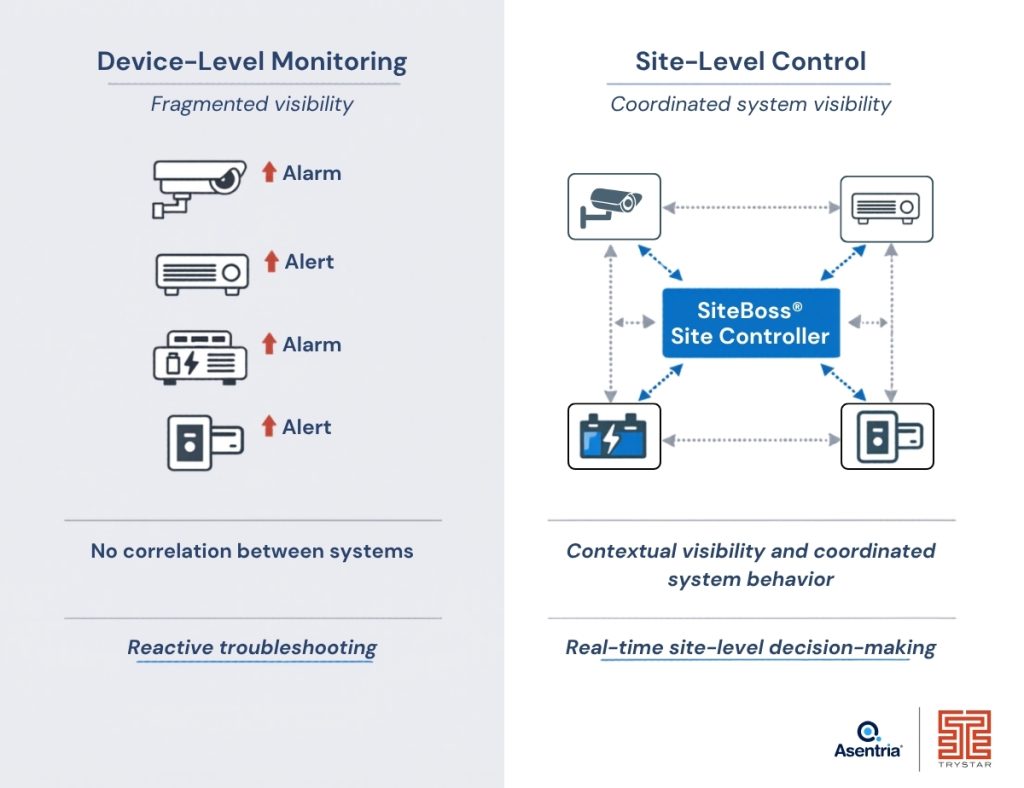
Traditional monitoring architectures are designed around device-level visibility. Each subsystem reports its own state, typically through alarms or status indicators, without providing insight into system-wide interactions.
This model introduces several limitations in post-deployment environments. Alarm correlation is limited, making it difficult to identify causality across power, environmental, and network systems. Dependency relationships between subsystems are not represented, preventing accurate interpretation of multi-system events. In addition, reliance on centralized processing introduces latency and dependency on backhaul connectivity.
Under these conditions, system behavior is observed as a collection of isolated events rather than as a coordinated process. Small disturbances, such as transient power instability or environmental drift, can propagate across dependent systems, amplifying initial disturbances into multi-system operational failures.
Site-Level Decision-Making Under Real-World Conditions
Operational resilience depends on the ability to interpret and respond to conditions at the site where they occur.
In distributed infrastructure, system state can change faster than centralized systems can process and respond. This is particularly evident during power events, where switching operations, equipment restart sequences, and environmental stabilization occur within short timeframes. The sequence and timing of these events directly affect whether a site returns to a valid operational state.
If decision-making is delayed or dependent on remote systems, the relationship between events can be lost. This leads to incomplete recovery, inconsistent system behavior, or the need for manual intervention.
Site-level decision-making addresses this by enabling local evaluation of system conditions. Instead of reacting to isolated alarms, the system evaluates state transitions, system dependencies, and environmental conditions in real time. This allows responses to be aligned with actual site behavior rather than inferred conditions.
Site-Level Monitoring and Control Architecture
The SiteBoss® Site Controller is designed to implement this site-level operational model.
Rather than replacing existing infrastructure, SiteBoss operates as a monitoring and control layer that integrates power systems, environmental inputs, access control, and network equipment into a unified framework. It does not perform power switching, nor does it alter the operation of systems such as automatic transfer switches. Instead, it observes and interprets their behavior.
Edge data is collected locally, and site-level logic is applied to evaluate power state transitions, equipment availability signals such as device status, startup behavior, and defined operational thresholds, and environmental conditions. By evaluating these factors together, the system determines whether site conditions meet the requirements for stable operation.
This process effectively validates site state after dynamic events, rather than assuming correct system behavior based on isolated status indicators.
This evaluation occurs directly at the site and does not depend on continuous connectivity to centralized systems. Local execution ensures that system behavior is interpreted in context, preserving the sequence and relationship of events as they occur.
SiteBoss integrates with existing infrastructure using standard interfaces and open protocols, allowing it to be deployed without requiring modification of established systems or replacement of legacy equipment.
Architecturally, this model shifts operations from device-level monitoring to site-level control, where system behavior is understood as the result of interactions between subsystems rather than as independent events.
Implications for Long-Term Network Operations
Post-deployment network performance is determined by how effectively operators can interpret and manage system behavior over time.
When visibility is limited to device-level status, operations become reactive. Alarm volume increases, troubleshooting cycles lengthen, and site visits become necessary to validate system conditions. This increases operational expenditure and reduces overall system reliability.
By contrast, site-level monitoring and control enable a continuous understanding of how systems behave under real operating conditions. Event relationships are preserved, system dependencies are visible, and abnormal behavior can be identified before it escalates.
This approach reduces the need for manual validation, improves the consistency of system operation, and supports scaling without proportional increases in operational complexity.
| Aspect | Traditional Monitoring | Site-Level Control |
| Visibility | Device-level | System-level |
| Response | Reactive | Real-time |
| Power events | Not contextualized | Fully evaluated |
| Troubleshooting | Manual | Condition-based |
| Scalability | Limited | Operationally scalable |
Conclusion
Deployment validates that systems can function under controlled conditions. Long-term operation determines whether those systems perform reliably under real-world variability.
In distributed environments, network visibility after deployment must extend beyond device status to include the interaction between power, environmental, and infrastructure systems at the site level. Without this context, network behavior becomes difficult to interpret, and operations become reactive.
By enabling site-level visibility, localized decision-making, and coordinated system evaluation, Asentria provides the operational foundation required to maintain reliable and scalable network performance after deployment.
This distinction defines the difference between network availability and operational reliability.
📍 Learn how Asentria supports long-term network operations at www.asentria.com/contact
Frequently Asked Questions
Network visibility breaks down because monitoring systems transition from controlled deployment environments to complex operational conditions. Power variability, environmental factors, and system interactions introduce dependencies that are not captured by device-level monitoring, leading to fragmented visibility rather than complete loss of data.
Device-level monitoring reports the status of individual components, while site-level visibility represents how multiple systems behave together under real-world conditions. Site-level visibility enables operators to understand causality, system dependencies, and operational impact.
Power events introduce state transitions that affect equipment startup sequences, system timing, and operational stability. Without visibility into how systems respond to these transitions, operators cannot confirm whether the site has returned to a valid operational state.
Distributed systems operate under conditions where local changes occur faster than centralized systems can respond. Site-level decision-making enables real-time evaluation and response, preserving the relationship between events and preventing incomplete recovery or inconsistent system behavior.
Operational reliability is defined by the ability to maintain consistent system behavior under variable conditions. This requires continuous validation of site state, visibility into subsystem interactions, and the ability to respond locally to dynamic events rather than relying solely on centralized monitoring.